
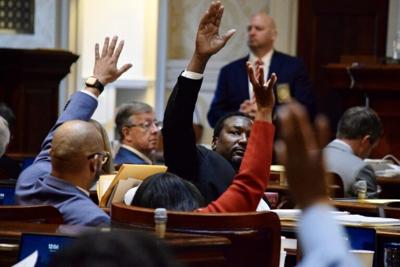
COLUMBIA — Republicans in the South Carolina House were on their way toward passing a new congressional map Tuesday when voters’ rights groups sued the chamber’s GOP leaders to stop the process.
The lawsuit in Richland County Court seeks to invalidate a mid-debate change to the rules. A hearing is set for 9 a.m. Wednesday on a request to put the process on pause pending a ruling.
Democrats said they expect the lawsuit to be the first of many against efforts to redraw South Carolina’s congressional lines in an effort to create an all-Republican congressional delegation.
House Republicans were expected to approve a new map just one week before early voting opens and after more than 2,100 absentee ballots have already been cast.
“What you all are doing is wrong,” said Rep. JA Moore.
“You can justify it, rationalize it, but it’s wrong,” the North Charleston Democrat added.
The state chapters of the League of Women Voters and American Civil Liberties Union sued Tuesday over the way GOP leaders dispensed with more than 500 of Democrats’ proposed changes.
To end the potential of debate dragging on indefinitely, the House Rules Committee adopted a rule Monday night limiting every legislator to one amendment and debate on each to three minutes.
The lawsuit alleges the hastily called meeting violated the state Freedom of Information Act, which requires public notice of meetings at least 24 hours in advance.
Notice of the meeting was posted just eight minutes before the committee convened and the meeting ended before members of the press could make it to the room.
In an email, the ACLU said the maneuver “laid bare just how hard Republicans are working to ram this through.”
House Speaker Murrell Smith contends the open meetings law doesn’t apply to the House Rules Committee.
“This is not a committee for the public,” the Sumter Republican said in overriding legislators’ complaints Monday night. “Internal workings of the House are not subject to FOIA.”
If left unchallenged, the lawsuit argues, that ruling would set a bad precedent that allows “legislative committees to conduct consequential public business in secret.”
The groups also allege the meeting violates FOIA because the late notice lacked details. And, while meetings needed for “emergency or exigent circumstances” can avoid the 24-hour rule, no one pointed to that as a reason, and it wouldn’t apply anyway, according to the lawsuit.
“Any urgency was manufactured by Republicans in the House who became frustrated by members whose debate and proposed amendments slowed Republicans’ attempts to steamroll the passage of the bill,” the lawsuit reads.
On Monday, it took Republicans 10 hours to get through nine amendments. On Tuesday, following the rule change, they moved quickly through dozens of amendments in an effort to adopt a map drafted by the National Republican Redistricting Trust.
Those rebuffed amendments included automatically sending out absentee ballots to voters who requested them for the first round, moving the lines so that downtown Columbia and Clemson aren’t in the same district, and mailing notices to all registered voters who have been placed in a different congressional district because of the redraw.
Rep. Beth Bernstein asked lawmakers to approve voter education via text message alerts, direct mail, signage at polling places, a toll-free hotline for questions and social media outreach
“When confusion becomes a barrier, a barrier becomes silence, and silence becomes a vote that was never cast,” the Columbia Democrat said.
The House measure would delay primaries until Aug. 18 for the state’s seven U.S. House seats. But as ballots have already been printed, the candidates’ names will still appear. As of Tuesday, the state Election Commission had already mailed out 11,300 ballots to absentee and overseas votes.
The state will spend an estimated $3.5 million to run a second set of primaries.
That estimate does not include costs incurred by county elections offices for expenses not covered by the state.
Rep. Roger Kirby, D-Lake City, suggested the state should help counties cover the bill, which elections officials expect will run counties hundreds of thousands of dollars.
Estimates provided to the state Election Commission by county offices include $526,000 in Charleston County, $124,000 in Greenville and $443,000 in Richland.
In Kirby’s home county of Florence County, estimates came to about $202,000.
Meanwhile, the state spent at least $203,000 on pay for House members during the special session. The cost will increase with senators’ return to Columbia.
The effort to redraw South Carolina’s lines to create seven Republican seats followed a U.S. Supreme Court ruling that threw out Louisiana’s congressional map, striking down a majority-Black congressional district as an unconstitutional racial gerrymander.
Supporters say it’s necessary to “un-gerrymander” the state’s only district held by a Democrat, the 6th District. Longtime U.S. Rep. Jim Clyburn has held the seat since voters elected him in 1992.
Opponents pointed out that the U.S. Supreme Court has already ruled in 2024 that South Carolina’s map, redrawn after the 2020 census, was partisan, not racially, gerrymandered.
And some members of both parties have questioned the wisdom of targeting Clyburn, who has helped secure massive federal investments over his 34 years in office.
“The consequences do not end with politics,” said Rep. Rosalyn Henderson-Meyers. ”The consequences will affect real people across our state.”
Congressional representation can decide South Carolina’s share of federal dollars for rural health care, maternal health, education, roads and bridges and small businesses, the Spartanburg Democrat added.
“And more importantly, it will impact whether our constituents continue to believe that their voices matter in our democracy,” Henderson-Meyers said.
SC Daily Gazette is part of States Newsroom, a nonprofit news network supported by grants and a coalition of donors as a 501c(3) public charity. SC Daily Gazette maintains editorial independence. Contact Editor Seanna Adcox for questions: info@scdailygazette.com.