
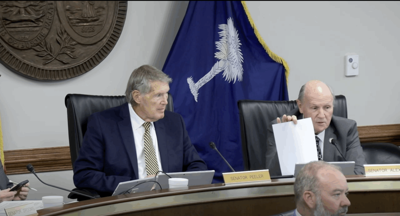
COLUMBIA — Senators advanced a bill Tuesday that would conform with federal income tax changes one last time, saying the Legislature needs to end confusion over how people file their returns this year.
Despite initial hesitation from some senators, the Senate Finance Committee advanced the bill Tuesday on a 17-2 vote. The “no” votes came from GOP Sens. Greg Hembree Little River and Sean Bennett of Summerville, who’s long fought for an overhaul of the state tax system. The House passed the bill unanimously last week.
“April 15 is coming up,” Senate Finance Chairman Harvey Peeler said, referring to the deadline for people to file their taxes. “Taxpayers in this state don’t have time for squabbling between the House and the Senate.”
The Senate should advance the bill as quickly as possible, the Gaffney Republican said.
“I think we’ve waited long enough,” he added.
Adopting the federal tax code, as legislators usually do, would mean allowing filers to take advantage of the tax breaks included in the One Big Beautiful Bill Act passed by Congress last summer. Changes include bigger breaks to seniors and exempting tips and overtime pay from taxes.
The bill is expected to reduce state revenue by $288.5 million in the fiscal year starting July 1. And that’s on top of a $309 million revenue cut in 2026-27 from a bill reducing income tax rates, which is already on its way to Gov. Henry McMaster.
Plus, the Senate passed a bill that would cut an additional $259 million in senior homeowners’ property taxes. Those taxes are collected by counties, not the state, but the bill would reimburse counties for the lost revenue.
If all three tax-cutting bills become law, they’ll collectively cut state spending by about $860 million next fiscal year.
That could eliminate all of the new money predicted in 2026-27 from a growing economy, plus draw down this fiscal year’s expected surplus, according to November revenue predictions from the Board of Economic Advisors. Those predictions will be updated before the budget’s finalized.
The state budget can absorb the cuts, said Sen. Wes Climer, a Rock Hill Republican who is also running for Congress.
“I don’t think that it’s necessarily the case that tax conformity and property tax cuts are mutually exclusive propositions,” Climer said. “They’re only mutually exclusive insofar as the Legislature chooses to spend money that could otherwise go back to the people of South Carolina.”
If legislators make such a large cut this year, though, filers will feel like their taxes are going up next year when the state decouples from the federal government and sets its own rules for collecting taxes, Bennett said.
“I think this is a bad idea,” he said.
Either way, a change will almost certainly cause confusion, senators said. Not passing it will leave accountants guessing until the deadline. Passing it would mean early filers have to redo their taxes.
Senate President Thomas Alexander has already been to his tax preparer once, he said.
A second trip might cost the Walhalla Republican another hundred dollars or so, and other taxpayers are likely to face similar costs if the Senate agrees to change how taxes are filed, he said.
Senators made no changes Tuesday to what the House passed. But amendments to help taxpayers who have already filed their taxes could be part of the floor debate.
SC Daily Gazette is part of States Newsroom, a nonprofit news network supported by grants and a coalition of donors as a 501c(3) public charity. SC Daily Gazette maintains editorial independence. Contact Editor Seanna Adcox for questions: info@scdailygazette.com.