
COLUMBIA — A bill meant to rev up road construction in South Carolina using optional toll roads and a state-run environmental permitting process passed the House on Wednesday.
The version of the bill the House passed unanimously veered away from what the Senate passed last month by getting rid of a program incentivizing local governments to take over maintenance of certain state-owned roads. It would also eliminate the commission that oversees the Department of Transportation, instead moving the agency under the governor’s control.
The bill will go back to the Senate, which can either agree to the House’s changes or convene a committee to hash out the differences between the two proposals.
The two chambers agreed on several major parts of the proposal.
Like the Senate, the House’s proposal would allow the transportation department to place optional tolls on newly constructed highway lanes and give the state control of environmental permitting processes usually overseen federally.
A requirement that the transportation department repair potholes within a week of a person reporting one online also remained in the bill.
Both chambers opted not to increase fees for electric vehicle owners under the bill.
A 2017 road-funding law enacted biennial fees on electric vehicles — $120 for fully-electric cars and $60 for hybrids — to help cover road costs. But that doesn’t cover what their drivers would otherwise pay at the pump through gas taxes. To bridge that growing gap, legislators flirted with increasing the EV fees to $400 every other year.
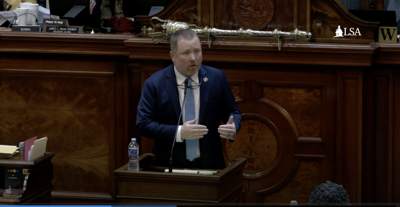
But the House removed that proposal because it proved too divisive, said House Ways and Means Chairman Bruce Bannister, whose committee advanced the bill.
Incentives for cities and counties to maintain their own roads met a similar fate in the House. The bill specified the buyback program was optional, but opponents called it an unfunded mandate that local governments couldn’t afford.
Bannister said it was easier to just “take it out and have that discussion another day” than correct the misinformation.
“I believe everybody plugged it into AI, and it spit out, ‘It’s going to require you to do this, and it’s going to raise taxes,’ and everybody just formed an opinion about what it did before they read it,” Bannister told reporters.
With those portions removed, the bill gained unanimous support, even from previous opponents. Among them was Rep. Joe White, who was so strongly opposed to the bill he hosted a solo news conference Monday to decry the voluntary road buyback program.
With that gone, White removed all 160 of his proposed changes to the bill and voted in favor.
“I think that this is a great first step,” said White, a member of the ultra-conservative Freedom Caucus member from Newberry.
The removal of the local road buyback program doesn’t mean the House is slamming the brakes on the idea, Bannister told reporters.
Both the House and Senate included money for a road buyback program in their proposed spending plans. Though the amounts differed, with the Senate including $12.5 million and the House proposing $25 million, some amount is likely to end up in the final budget.
That will probably come with instructions telling the transportation department to get the best deals possible in paying local governments to take care of roads in their areas. But no one would have to participate, Bannister said.
“Everybody’s got to agree to the process,” Bannister said.
Legislators need to do something to reduce the number of roads the transportation department manages, said Rep. Robby Robbins, who was chairman of the DOT Commission before becoming a legislator. The state could save both time and money if it didn’t have to worry about local construction and could focus instead on major thoroughfares, such as the state’s highways, he said.
“We have got to reduce the size of the state system,” the Summerville Republican said. “We’re not doing it in this bill, but we have got to do it.”
South Carolina has the nation’s fourth-largest state-maintained highway system, at more than 41,000 centerline miles.
The bill is meant to speed up the process of building and expanding roads, with the hopes of reducing congestion from a booming population and getting more major projects done, said Rep. Gary Brewer, who works for an engineering company that designs roads and bridges.
Construction delays, including those caused by permitting and multiple rounds of approvals, can drive up costs as prices rise, so accelerating the process can save money, Brewer said.
The transportation department estimates moving environmental permitting from the federal government to the state, which requires federal permission, could shave months to years off timelines.
“Instead of being eaten up in bureaucratic red tape, (money) will be put on the pavement where the rubber actually meets the road,” the Charleston Republican said.
Removing the commission and allowing the governor to instead appoint the transportation department’s director could also remove a layer of bureaucracy, said Bannister, chairman of the chamber’s budget-writing committee.
The governor appoints directors for 23 Cabinet agencies, with approval from the Senate. The most recent addition was the Department of Behavioral Health and Developmental Disabilities, which legislators put under the governor’s control after combining several smaller agencies in its creation last year.
Whether the Senate agrees with that sort of change, however, is unclear, Bannister said, noting “they have historically been very protective of the commission.”
Optional toll lanes, also known as “choice lanes,” could help raise money to pay for new major road expansion projects, legislators said.
The added lanes, which the Department of Transportation could partner with private companies to build and operate, would give drivers the option of paying a fee to bypass heavier traffic. The hope is that would clear up congestion for everyone on the road, including those in the free lanes.
The transportation department is floating the idea of using the optional tolls to widen the existing Interstate 526, or the Mark Clark Expressway, which connects Mount Pleasant to West Ashley in Charleston County. The revenues collected from tolls could cover at least half of the estimated $10 billion cost, according to agency figures.
“I would be thrilled to pay a little extra,” to get around traffic on Interstate 526, said Rep. Kathy Landing said.
SC Daily Gazette is part of States Newsroom, a nonprofit news network supported by grants and a coalition of donors as a 501c(3) public charity. SC Daily Gazette maintains editorial independence. Contact Editor Seanna Adcox for questions: info@scdailygazette.com.