
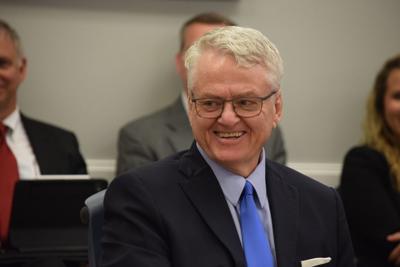
COLUMBIA — More than two years after the discovery of a $1.8 billion accounting error within the state’s books, South Carolina’s top banker continues to balk at taking out long-term loans for major construction projects at the state’s three research universities. This leaves the ultimate cost to public colleges — and therefore students and taxpayers — subject to shifts in interest rates.
Treasurer Curtis Loftis has declined to issue what are known as general obligation bonds, relying instead on stopgap funding for about $260 million in building costs across the three schools.
These so-called one-year bond anticipation notes, most commonly used to jumpstart a project until a full bond is put in place, aren’t uncommon.
They do, however, carry risk.
The latest such funding measure will be for a $58 million renovation, approved this month by a pair of state fiscal oversight panels, for the McKissick Museum on the University of South Carolina’s historic Horseshoe, the treasurer told the SC Daily Gazette.
Loftis’ avoidance is tied to ongoing fallout over a series of multibillion-dollar accounting errors that lingered on the state’s ledger for nearly a decade. He cited a desire for a more detailed explanation of what led to the mistakes and measures put in place to prevent recurrence.
Forensic accountants hired by the state have said the errors were a paperwork problem and involved almost no actual money. Still, the issue prompted a federal securities investigation that dates back to at least 2024 and continues to this day.
‘A little dicey’
As long as the U.S. Securities and Exchange Commission investigation remains open, Loftis said, turning to bonds backed by the state’s pledge of its taxing power and AAA credit rating “is a little dicey.”
Even so, it can be done, as long as he gets in-depth data he said the state’s accountant and interim auditor have denied him — a claim the comptroller general’s office has contested.
“They give us simple narratives and portions of narrative. We’ve never gotten good clear declaration of what that (accounting error) was and then how they fixed it,” Loftis said. “If we could get the information, we could probably solve most of these problems.”
Having that, Loftis said, would reassure him enough to sign his name to bond applications.
After all, as treasurer he must certify that state financial reports cited in the debt package contain no material omissions or errors. If errors are found, he could personally face financial penalties, he said.
On the other hand, taking out these one-year bridge loans, rather than locking in interest rates over a 20- or 30-year period, runs the risk of borrowing costs rising. Rates could also fall in the interim, but it’s a gamble.
The McKissick renovation joins a pair of previously approved projects on the campuses of Clemson University in the Upstate and the Medical University of South Carolina in the Lowcountry that have relied on this short-term funding method.
“We’ve been pretty lucky. These (interest) rates haven’t gone up, but they could. We live in uncertain times,” Loftis told the SC Daily Gazette. “And the other problem is the schools need that certainty.”
In 2025, he laid the blame on the senators tasked with investigating the errors, who he said were scapegoating him for the accounting problems.
Mixed reactions
Legislators who sit on the fiscal oversight boards that signed off on the college construction projects have differing takes on Loftis’ continued use of one-year financing.
House Ways and Means Chairman Bruce Bannister expressed confidence the treasurer was “actively working” to settle any disagreements with the comptroller’s office and just waiting for the end of the federal investigation.
Sen. Sean Bennett, on the other hand, thought the treasurer’s claims about a lack of information sharing appeared “dubious.”
The Summerville Republican, who works as a financial advisor, also stressed that the state’s building projects need to be financed appropriately because with loans that large, a couple basis points of interest can make a big difference on the cost of lending.
Clemson’s project, a new forestry and environmental conservation building and a research complex for developing new types of high-performance materials essential to modern day manufacturing, is the largest, with a price tag of $160 million.
MUSC’s classroom building for training new health care providers in the state is the smallest at $45.2 million.
Now, USC needs funds to turn its museum building into a student and visitors hub with classrooms, study areas, art exhibits, a café, a rooftop patio and event space.
A campaign issue
While Loftis doesn’t face a GOP challenger in his re-election bid, at least one Democrat running for the office plans to make the loans a campaign issue come November.
“This is all a shell game, because he won’t accept responsibility,” said Trav Robertson. “He won’t accept responsibility for being asleep at the wheel, and the taxpayers are bearing the burden for this.”
The former Democratic Party chairman previously worked as a spokesman to the last Democrat to lead the state’s bank: the late Grady Patterson, who was defeated in 2006 after four decades in the job. Based on that experience, Robertson suggested Loftis was avoiding the long-term bonds to sidestep a challenge to the state’s sterling credit rating.
Because the one-year notes are sold only to big banks and investors, they don’t require the treasurer to make the same accuracy pledge. Turning to the bonds might prompt the credit agencies to rate the debt for riskiness. Any time a government entity sells bonds to raise money, it relies on that credit rating to determine interest payments.
“That’s the real issue,” Robertson said. “He’s trying to get around the rating of any general obligation bonds because they’d recognize that he is financially unstable. They’d recognize that he doesn’t know what’s happening in his office.”
Origins of the error
The state’s woes began with an accounting error, discovered in 2022, which came from a computer coding glitch that mistakenly double-counted public colleges’ revenue for more than a decade in the state’s annual financial report provided to Wall Street investors.
That led to the 2023 resignation of Richard Eckstrom, who had been the state’s comptroller general since 2003.
The latest issue became public in early 2024 as part of a larger Statehouse investigation into that prolonged mistake.
In the wake of a chaotic, decade-long transition from the state’s old accounting system to a new one, $1.8 billion worth of ledger entries had piled up. As years passed, the origins of those bookkeeping marks were lost to time.
Senators dinged the treasurer for not telling them about the discrepancies earlier and voted 33-8 last year to oust him. But the House declined to take it up and Loftis, first elected 16 years ago, is now seeking another four-year term.
The combined accounting miscalculations in the state’s financial offices topped $5 billion.
Fortunately, the errors did not affect state budgeting, since the Legislature relies on revenue numbers from a different state agency altogether.
However, the Legislature spent $3 million on forensic accounting to get to the bottom of the issue. Findings by the Washington, D.C., firm showed all but $200 million of the $1.8 billion was only on paper — not actual cash. And the $200 million that was real wasn’t excess that could be spent.
In addition, the state has spent at least $10 million so far on legal costs associated with the investigation.
The forensic auditors drew up a to-do list to correct those paperwork errors and prevent a repeat. According to a report last month from a different outside firm, which the state paid another $1.2 million to make sure fixes went into place, nearly all the work is complete.
Still, Loftis is demanding more.
Demanding more
Loftis’ decision not to sign long-term bonds largely boils down to a lack of understanding on how numbers from the Treasurer’s Office get folded into the state’s annual financial report generated by the comptroller general.
The two offices, along with the compliance team, met weekly for about five months to train the treasurer and his workers on the process. The comptroller general also puts together written instructions the treasurer’s staff could use to make its own calculations.
The compliance team tested the instructions and deemed them sufficient. But Loftis has protested, claiming his team needs more to check the math.
Furthermore, the compliance team reviewed the comptroller’s annual reports going back to the year notations were made to inform investors of the accounting error. Loftis argues that review should go back a decade and the findings should all be turned over to him.
And though forensic accountants watched over the shoulder of the comptroller’s team as it made necessary corrections within the state’s digital accounting system, the state treasurer’s office wants copies of that documentation, too.
As for interest rates, the federal funds rate, the benchmark set by the Federal Reserve, has been on the decline since 2024 but whether that trend will continue has grown more uncertain. Minutes from the latest meeting of the central bank’s policymakers indicated a willingness to hike rates, especially if inflation climbs amid rising oil prices, Axios reported.
The current target rate range sits between 3.5% and 3.75%, down from 5.25% to 5.5% two years ago.
SC Daily Gazette is part of States Newsroom, a nonprofit news network supported by grants and a coalition of donors as a 501c(3) public charity. SC Daily Gazette maintains editorial independence. Contact Editor Seanna Adcox for questions: info@scdailygazette.com.