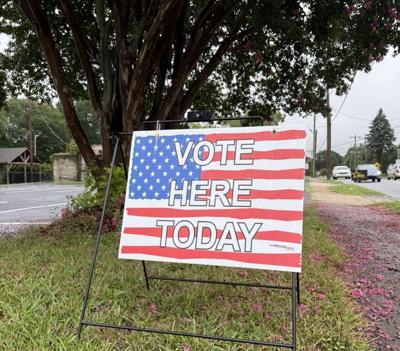
COLUMBIA — Voting begins in three weeks to determine who will replace the late Sen. Lindsey Graham as the GOP nominee on November’s ballot.
Only South Carolinians who voted in last month’s Republican contests or didn’t vote in the primaries at all can participate. Questions remain about voting for deployed military members and South Carolinians living overseas.
Under state law, the unexpected death of South Carolina’s senior senator triggered a special primary, scheduled for Aug. 11.
The state’s election agency then had to determine whether to treat it as a new election cycle, reopened to all registered voters, or an extension of the previous cycle, disallowing so-called crossover votes.
The decision means anyone who voted in the June 9 Democratic primary and/or the June 23 Democratic runoffs can’t vote next month.
Essentially, people who helped determine the Democratic nominee in June can’t turn around and determine the Republican nominee in August. While the special election will involve an entirely new slate of candidates, the selection involves the same ballot.
“We feel comfortable at this point to go with this direction,” Belangia said.
The opinions, from 1992 and 1976, stated registered voters who voted in a party’s primary for a candidate to fill a certain office were not then eligible to vote in the opposing party’s subsequent special primary for that same office.
The 1976 opinion, in particular, involved a special election held to fill a vacancy created by the death of the Democratic Party nominee for solicitor in Lexington County.
And as for the oath Belangia cited, it reads: “I do solemnly swear or affirm that I am duly qualified to vote at this primary election and that I have not voted before at this primary election or in any other party’s primary election or officially participated in the nominating convention for any vacancy for which this primary is being held.”
Early voting for the special primary also will be treated similarly to a runoff, with polls open from 8:30 a.m. to 5 p.m. on the Wednesday through Friday before election day. That means early voting is just three weeks away.
The state Election Commission will meet Aug. 14 to certify the results.
If a runoff is required, the same process will apply. Early voting Aug. 19-21, election day on Aug. 25 and certification on Aug. 28.
Problems arise when it comes to military members serving overseas.
State law is specific about the timeline for a special election in the case of a nominee’s death. But that state law passed in 1991, 18 years before Congress amended federal law to require overseas ballots be mailed out 45 days before any election.
Candidate filing for the primary ballot begins at noon July 21. The deadline of noon July 28 leaves just two weeks before the primary. And that’s not nearly enough time to meet the federal deadlines.
“It’s not an opportune situation,” Belangia said.
Belangia said the Election Commission has contacted the U.S. Department of Justice and is waiting for a response. But regardless of what the federal officials decide, the special election will go forward as planned.
“We’re following state law,” Belangia said. “We can’t afford to sit back.”
Belangia said the vast majority of overseas votes are cast electronically. Of the 1,003 ballots cast in the primary, all but 48 were cast electronically.
Of those 48, Belangia did not immediately know how many had voted in the Democratic primary, making them ineligible for the upcoming special GOP primary.
In the meantime, Belangia is urging county elections officials to prepare for an election that will take place after many public school districts have resumed class.
“That Tuesday is the first day of school for many places, and it’s going to be a mad house,” Belangia said.
Nearly a quarter of the state’s polling places are in schools, leaving officials looking for alternative locations where possible.
Participation
Last month, Graham defeated five GOP challengers with 57% of about 465,100 votes cast, according to state Election Commission data.
On the Democratic ballot, Annie Andrews won a three-way race with 61.5% of more than 367,400 votes.
That meant both Graham and Andrews avoided a runoff. In South Carolina, if no candidate gets more than 50% of the vote in a primary, the top two vote-getters advance to a runoff.
It also means a lot of people didn’t exercise their right to vote; 75% of registered voters didn’t participate in either party’s primary.
A runoff will likely be necessary to determine a winner after the Aug. 11 primary. If so, it will be Aug. 25.
Dates at a glance
- Aug. 5-7: early voting
- Aug. 11: special GOP primary
- Aug. 19-21: early voting
- Aug. 25: primary runoff
SC Daily Gazette is part of States Newsroom, a nonprofit news network supported by grants and a coalition of donors as a 501c(3) public charity. SC Daily Gazette maintains editorial independence. Contact Editor Seanna Adcox for questions: info@scdailygazette.com.