
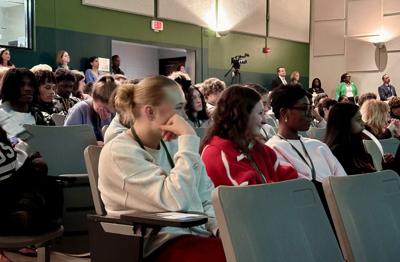
COLUMBIA — Jazz’e Spencer has played soccer — a center back defender — for 14 years. Now the Dutch Fork High School senior dreams of studying sports medicine, either at the University of South Carolina or College of Charleston, to help her fellow athletes treat injuries early so they can stay in the game.
One look at the cost of college, however, and the prospect is daunting.
Before scholarships and financial aid, her top-choice schools are expected to cost between $31,600 and $35,300 annually on tuition, supplies, meals, housing and other expenses.
With an older sister attending college in another state, she’s seen the numbers and Spencer is left worrying about the expense of her own education.
“It’s like how am I gonna pay for this?,” she said. “It makes it a little nerve-wracking.”
So, when representatives of the nonprofit Meeting Street Scholarship Fund came to her school Monday to talk about a new opportunity for high-achieving, low-income South Carolina students to receive as much as $40,000 toward their college education, it gave her hope.
“It would take a lot of the load off,” Spencer said. “And my mom, I think she would worry a little less.”
Scholarship program expands
It comes after legislators included $18.7 million in the budget to expand Meeting Street Scholarships statewide.
“We want to make sure we keep our best and brightest in state, and this is a way to do that,” said Republican Rep. Nathan Ballentine, who chairs the House’s higher education budget panel and whose district includes Dutch Fork High School.
The scholarship, available to students who meet income requirements for a federal Pell Grant, fills gaps not covered by other aid — up to $10,000 annually for students who keep at least a B average.
‘A huge relief’
The program also added a work requirement to give recipients on-the-job experience.
Starting this school year, students in their second and third years of college must work 250 hours to keep their scholarship. That can include a part-time job on or off campus, internship, or research.
More than 80% of recipients were doing that anyway, according to Beemok Education, which runs the Meeting Street fund.
Lexington-Richland School District Five Superintendent Akil Ross put that in perspective for the Dutch Fork High School seniors, many of whom work minimum wage jobs when they’re not at school. To earn $10,000 at those jobs, they’d have to work for more than half the year.
“Eight and a half months of real work, full-time work, can be given to you because you did what you had to do in the classroom,” he said.
State lottery profits will pay for an estimated 2,300 scholarships awarded next school year. If applications exceed estimates, Meeting Street founder Ben Navarro previously said his nonprofit will make up the difference.
“It’s a huge relief to see that South Carolina has opportunities,” said Christiana Ross, of Irmo. “As far as staying in state, that’s a huge motivation because it’s easier on our parents and ourselves.”
The Dutch Fork senior hopes to attend Coastal Carolina University to study early childhood education and pass on her love of learning.
“Education is something that’s really important to me,” she said. “I know sometimes in school, it’s a process dealing with teachers who you feel like don’t support you or classes that may feel challenging. Being a teacher that helps children want to learn, I think, will make a difference.”
The Meeting Street fund began as a scholarship for Charleston County high school students, starting with the Class of 2021. It spread to 14 counties with private donations from the Navarros and other philanthropists.
In the 14 “legacy” counties, private donations will continue to fully fund scholarships. The state will cover the 32-county expansion.
More funding needed
Once fully implemented in 2030, when today’s eighth graders become eligible, roughly 10,000 students annually will be attending college with a Meeting Street Scholarship. But meeting that goal will require legislators to approve more dollars. Paying for next year’s freshmen and sophomores in the program will require than $30 million next year.
By year four, it will take an estimated $60 million each year.
House Ways and Means Chairman Bruce Bannister said it’s too early to say whether the state will have the money available but expressed support for the effort.
“Giving an opportunity to those kids who are right on that bubble and can’t afford college otherwise, I think that’s a great investment,” the Greenville Republican said.
The scholarship stacks on top of Pell Grants, which can range anywhere from $740 to nearly $7,400, and state lottery-funded LIFE or Palmetto Fellows scholarships, which range from $5,000 to $10,000 annually.
On average, the Meeting Street scholarships fill a $7,900 gap after other aid, according to Beemok Education.
The program also has a history of success.
Of the nearly 2,220 students awarded a scholarship since 2021, 88% of them have either graduated or remain in college. And of the program’s graduates so far, 70% left college with zero debt, and 80% stayed in South Carolina to work.
Applications for the program open Nov. 9.
Meeting Street expansion
The following is a county-by-county estimate of new recipients annually of the scholarship funded with lottery profits, based on data from the census and state Commission on Higher Education:
- Greenville: 273
- Richland: 227
- Lexington: 175
- York: 153
- Horry: 141
- Berkeley: 120
- Dorchester: 101
- Anderson: 97
- Beaufort: 75
- Pickens: 61
- Aiken: 51
- Sumter: 44
- Lancaster: 40
- Orangeburg: 39
- Laurens: 38
- Kershaw: 38
- Georgetown: 38
- Oconee: 32
- Greenwood: 30
- Chester: 23
- Newberry: 21
- Cherokee: 19
- Colleton: 18
- Chesterfield: 18
- Hampton: 16
- Fairfield: 15
- Union: 15
- Edgefield: 15
- Abbeville: 14
- Calhoun: 11
- McCormick: 8
- Saluda: 7
- Private and home schools statewide: 151
Source: Beemok Education
SC Daily Gazette is part of States Newsroom, a nonprofit news network supported by grants and a coalition of donors as a 501c(3) public charity. SC Daily Gazette maintains editorial independence. Contact Editor Seanna Adcox for questions: info@scdailygazette.com.