COLUMBIA — Michael Davis set off from Awendaw, a small town in Charleston County, around midnight Friday, Dec. 12.
He planned to run to Columbia by Sunday.
Davis’ goal was possible for the first time this year after nonprofit Palmetto Conservation Foundation completed a 218-mile stretch of paths connecting the state’s capital to its coast. Over the next five to seven years, the nonprofit wants to finish its 30-year goal of connecting about 520 miles of trail extending across the state.
The stretch from Columbia to Awendaw marked a major piece of that. The final, 26-mile piece, named Boyd Passage after the prominent Columbia family that sponsored it, opened to the public over the summer.
Soon after that trail opened, Davis, who has done long trail runs in the past, considered trying to run the whole thing.
“‘Hey, we’ve got a very unique section of trail here that comes right into Columbia, and that would be really cool to do,’” the 46-year-old recalled thinking.
Because of the time commitment, however, the idea seemed too far-fetched. Davis put the idea in the back of his mind for several months, until he attended a banquet for nondenominational Christian ministry Young Life and began to come up with a plan.
Touched by the stories of children the ministry helped, Davis decided to run the entire 218 miles in three days as a fundraiser to pay camp fees. People could pledge between 50 cents and $10 per mile or opt to make a single donation.
By the end of his trek, Davis raised nearly $12,000 — enough to send at least two dozen children to camp, he said.
Davis’ story
Running past palmetto trees on the fishing inlet of Awendaw, Davis set off in the middle of the night toward his home in Blythewood, just north of Columbia.
What stood out to Davis as he made his way across the state was how different the trail could be from one moment to the next.
He’d run through glades of pine trees, their needles blanketing the path, followed miles later by swampland, cypress knees jutting out of the water on either side of him. In what felt like moments, that could turn into hardwood trees, shedding their leaves for the winter.
For about 47 miles, he ran through remote swampland, where he saw not a hint of civilization until the trail neared U.S. Highway 52 near Bonneau, and he watched the cars whiz past. At other points, such as when he reached Columbia, the trail turned into sidewalks along busy streets.
“The varying terrain that you encounter along the trail, it’s a little bit of everything,” Davis said. “I think it represents South Carolina well.”
Davis made it as far as Eutawville, about 100 miles into the run, before painful blisters covering his feet forced him to stop. His goal of completing the trek in just three days turned out to be too ambitious for his body, with the rapid pace causing severe pain.
Even though he knew he wasn’t going to be able to finish the run by Sunday, Davis didn’t want to quit. So, the team of about 15 people who signed up to accompany him and bring him meals stepped in. Davis hopped in the van they’d loaded up with gear, and his team did the next 110 miles or so as a relay race, he said.
Davis met up with them again outside Columbia’s Fort Jackson. Ignoring the painful blisters on his feet, Davis ran the final seven miles with his crew behind him.
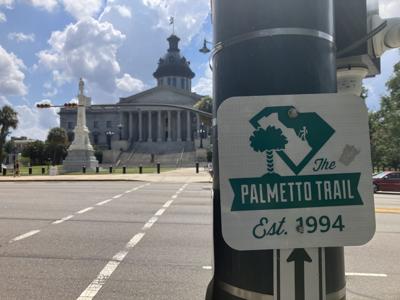
Near the end, Davis, a civil engineer and road designer, deviated from the designated path slightly to run up South Main Street toward the Statehouse. He was on the team that designed the renovations on South Main, which opened in July. With a police escort behind him, he knew this was a once-in-a-lifetime chance, he said.
“For a brief moment, all the pain went away, and it was pure joy that I was going again,” Davis said. “Shortly thereafter, reality set in, and it was a struggle. But I made it that last seven miles.”
Davis reached the Columbia Canal just before 3 p.m. Saturday. At the time, he told himself he would never try that again, but just a day later, he was already thinking about his next trip, he said.
Once the full trail is finished, Davis would like to try and run the length of the state. He acknowledged that would mean slowing down from his attempted breakneck pace, which would mean asking more from the people who volunteered to help him from his fitness group.
Any sort of extended trail run involves a lot of coordination to get food, water and other gear while on the trail. For safety reasons, Davis likes to keep a second runner with him as often as possible, especially at night.
But if he could figure out the logistics, he would do it, he said.
“I would love that, more than anything,” he said. “The biggest part of it is time.”
The Palmetto Trail
Davis’ weekend run is the sort of thing the trail’s stewards envisioned. Of course, few people are going to run the entire trail, but connecting the pieces gives people the option to enjoy it however they please, said Mary Roe, the nonprofit’s executive director.
“Whether it’s a small, 10-minute hike or a 10-mile hike, the trail is a natural resource for people in the state to enjoy,” Roe said.
The trail still has some significant gaps, Roe said. One big obstacle is the Tyger River in the Upstate, which the trail must cross for completion. That means building a bridge, which is an expensive prospect, though how much will depend on the exact plans.
For the moment, staff are focused on expanding the trail out from Columbia, past Lake Murray, and to Newberry, which is about 40 miles northwest by road, Roe said. That will give people a longer contiguous trail to hike before it eventually connects to pieces in the Upstate.
The trail reaches 410 miles in separate pieces. Over the next five to seven years, Roe hopes to see another 120 miles or so added to connect the rest of them. Those numbers could change if the routes don’t happen as planned, though she was hopeful for the trail’s future, she said.
“Will it be challenging?” Roe said. “Sure. But I can say that we’ve got a lot of good trail movement and a lot of good discussions happening.”
The nonprofit sometimes builds pieces of trail on its own and sometimes works with other organizations to designate existing trails or help with upcoming trails to add to the network.
For instance, the Saluda Grade Trail, a 31-mile stretch of abandoned train rail turned trail stretching from Inman into North Carolina, will join the Palmetto Trail when it eventually opens. Work to transform the property into a trail is underway, according to the nonprofits running the project.
Connecting the Palmetto Trail to major pathways in other states, including North Carolina, is a step closer to a major goal for Roe. Eventually, she wants to see South Carolina’s trail system integrated into larger systems, perhaps even feeding off the Appalachian Trail.
For the time being, though, the focus is on connecting the state in one long “spine” of a system, as she called it. The 218-mile stretch from Columbia to Awendaw represented a major step toward that, she said.
“I think it legitimized us,” Roe said. “We really are building the largest trail project in South Carolina.”
Although much of the nonprofit’s funding comes from donations, close to $9 million has come from the state Legislature since 2014. That included $1 million in the current budget, which runs until the end of June.
The cost to open a section of trail varies, Roe said. For the 26 miles that opened this year, the Boyd Foundation donated $1.5 million. Upkeep and maintenance also come with a cost, as volunteers repair sections of trail.
The trail is also popular, especially after outdoor recreation boomed during the COVID-19 pandemic, Roe said.
The security cameras installed at certain trailheads get almost constant pings during the day, as people stop to eat lunch, take short walks or go for long hikes. She hopes the trail will become an economic driver, too, bringing outdoorsy tourists to the state and sending people through small towns they may not have visited otherwise.
“I think it’s a really special asset for the state of South Carolina,” Roe said.
SC Daily Gazette is part of States Newsroom, a nonprofit news network supported by grants and a coalition of donors as a 501c(3) public charity. SC Daily Gazette maintains editorial independence. Contact Editor Seanna Adcox for questions: info@scdailygazette.com.