
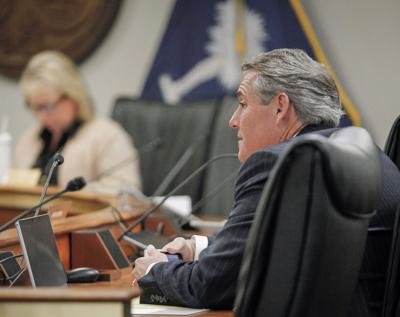
COLUMBIA — The Senate’s revision to legislation cutting state income tax rates would give more South Carolina taxpayers a break in year one.
Under the amended bill approved 39-5 Tuesday, 43% of tax filers would pay less this calendar year — which means tax filings due in spring 2027. Almost 23% would pay more, while 35% would see no change. Four Democrats and one Republican voted “no.”
The Senate adopted the amendment without debate, which adjusted what the House passed last year.
Overall, the Senate plan reduces income tax revenue by $308.7 million in its first year. That compares to $119.1 million in the House plan, according to predictions updated last month by the state Revenue and Fiscal Affairs Office.
The House will have to decide whether to agree to the Senate’s changes or work toward a compromise. Any tax cut plan will have to become part of state budget negotiations. Floor debate on the first House spending plan for 2026-27 starts in two weeks.
The income tax plan, combined with the bill senators advanced last week that expands property tax breaks on seniors’ primary homes, could reduce what’s available for legislators to spend in the coming fiscal year by $556 million total.
The bill still decouples the state’s income tax code from the federal system. South Carolina is one of just five states that have historically based state filings on federal taxable income — so, tax filers started their state calculations with less to tax.
That’s why South Carolina’s top marginal income tax rate of 6% appears so uncompetitive, when in actuality, what South Carolinians pay is comparatively low.
That was the case even before a 2022 law brought the top rate down from 7% and eliminated $1.3 billion in revenue.
Republicans’ argument for untethering from the federal system is that South Carolina shouldn’t let its tax code be subject to the whims of Washington. But the push to restructure was really fueled by a desire to stop appearing like the highest taxing state in the Southeast and instead stand out as a low-tax state. Decoupling allows truer state-to-state comparisons.
“It actually levels the playing field with our neighboring states,” said Sen. Ross Turner, R-Greenville. “We’ve never really been able to compare apples to apples, saying, ‘We’re this and North Carolina’s this.’”
However, the massive federal tax package signed by President Donald Trump last summer threw an unexpected twist in legislators’ efforts.
Conforming to the federal tax code’s new breaks would reduce state revenue by an estimated $515.4 million in the coming fiscal year. The combination of tax-cutting plans passed by the Legislature may actually exceed that amount, even in the first year, though taxpayers are impacted differently.
The legislation calls for continued cuts to state income tax rates in the future as the economy grows.
But not passing legislation adopting federal tax changes — as the Legislature normally does — also means taxpayers are having a harder time filing their tax returns this season. Two systems require different calculations. They’re not getting the breaks they’re expecting. It may be unclear what they owe. And legislators are hearing about it.
Sen. Wes Climer said he generally agrees with the state having its own taxing structure, but staying aligned with the federal code would provide a bigger cut in income taxes next year.
“I would argue we’re a little shy on this tax cut,” Climer said about the bill before voting in favor of it.
In response, Turner said South Carolina filers will be better off in the future if the state breaks free of the federal system. Legislators would rather be in control of tax collections instead of relying on Congress, which might lower taxes one year but raise them again later.
For example, some of the major provisions of the Trump-signed “one big, beautiful” law, such as no taxes on tips or overtime, phase out in 2028. Any extension may come down to who’s president and which party controls Capitol Hill.
“Even though this one-year blip may fall in (taxpayers’) favor, long-term, I don’t believe staying in the situation we are right now is a benefit to anybody in South Carolina,” Turner said.
Sen. Tameika Isaac Devine was among the five voting “no.”
The Columbia Democrat said she supports the idea of tax reform but felt the plan was rushed and didn’t do enough to help those who needed it the most.
“I would rather put that money in resources that we need in the state,” she told reporters after the vote.
Other senators questioned why some people would see their taxes go up under a bill touted for cutting what people owe.
Aside from getting rid of the state’s income taxes completely, which would blow a $6.6 billion hole in the state budget, any income tax change would require some people to pay more because so many are paying nothing, Turner said.
Nearly 45% of tax filers pay zero state income taxes, while 10% pay about 65% of the state’s income tax collections, according to the state Revenue and Fiscal Affairs Office.
Under the amended bill, 35% of filers would still pay no state income taxes, according to the office’s predictions.
“When someone goes from paying zero to paying $20, yes, they had a tax increase,” Turner said. “Welcome to the game.”
The bill sets an eventual goal of someday eliminating the state’s income tax altogether. It would require a $200 million cut each year that income tax collections grow by at least 5%.
Some senators questioned whether the state would ever get there. Each time the income tax rate goes down, the state will face diminishing returns, pushing the goal of eliminating the income tax further and further into the future, said Sen. Russell Ott, D-St. Matthews, who was among the “no” votes.
“That’s the math that I wasn’t mathing with exactly,” Ott said. “That’s not possible, correct?”
“I would say we won’t be here to see it,” Turner replied.
SC Daily Gazette is part of States Newsroom, a nonprofit news network supported by grants and a coalition of donors as a 501c(3) public charity. SC Daily Gazette maintains editorial independence. Contact Editor Seanna Adcox for questions: info@scdailygazette.com.