
COLUMBIA — One thing is certain about 2026: Politicians will make a lot of promises about cutting South Carolina taxes.
How much will be cut? And which tax?
Don’t believe candidates for the Governor’s Mansion (in either party) who pledge that they will eliminate state income taxes — no matter how loudly or how often they say it. For starters, the South Carolina governor doesn’t have the authority to unilaterally change tax policy. Period. That is entirely up to the 170-member Legislature.
Sen. Sean Bennett, who a year ago was considering a bid for governor, calls those campaign promises “pie in the sky.”
“They sound good, particularly in election years on the stump: ‘Let’s just eliminate our income tax,'” said the Summerville Republican.
The financial planner calculates the move would require at least doubling the state’s 6% sales tax: “I wish we wouldn’t waste time chasing that shiny lure.”
He is hopeful, however, about traction on the type of sweeping changes to the state tax code he’s advocated for years.
Legislation that further cuts state income taxes is in the Senate’s court, after passing the House by a vote of 68-46 in May during the last week of the 2025 legislative session.
What Congress did two months later provided a boost to state House GOP leadership’s arguments, though probably not in the way you’d think.
The “One Big Beautiful Bill Act,” which President Donald Trump signed July 4, is expected to reduce state income taxes by $515.4 million in the fiscal year starting July 1, according to a recent analysis by the state Revenue and Fiscal Affairs Office. The state’s revenue forecasters expect the federal law to further reduce collections by $244 million in 2027-28 and $251 million in 2028-29, when some of its major provisions — such as no taxes on tips or overtime — will phase out, leaving tax impacts beyond that a mystery.
But there’s a giant “if” in those predictions. The reductions will occur if the Legislature adopts the federal tax code changes.
That’s what the General Assembly normally does: South Carolina is among just a handful of states to tax “federal taxable income.”
The argument for decoupling
But a major reason that House Republicans gave last session in pushing their tax restructuring plan was to decouple South Carolina’s income tax code from the federal system.
House GOP leaders recently told the SC Daily Gazette they believe the Trump-signed tax law — and state forecasters’ analysis of its impact to state tax collections — increase the need for South Carolina to untether and do its own thing.
“It shows what happens when we give away the tax-making authority of the General Assembly to Washington,” said Rep. Brandon Newton of Lancaster, chairman of House Ways and Means’ tax policy subcommittee, which advanced the bill he co-sponsored.
“We can’t be at the mercy of whatever D.C. does, whether it’s President Trump or President AOC,” he continued, referring to progressive Rep. Alexandria Ocasio-Cortez of New York, while stressing, “even though I agree with the changes made by President Trump.”
More importantly for the bill’s chances, the Senate’s budget chief agrees.
“We want to decouple from the feds,” said Senate Finance Chairman Harvey Peeler, R-Gaffney. “South Carolina doesn’t need to depend on Congress.”
Bennett, who chairs two of Senate Finance’s regular subcommittees, believes the “Big Beautiful Bill” not only strengthens the case that state tax collections should not be “dependent on the whims of the federal government,” it highlights the need for a total overhaul.
“Let us decouple and put together a South Carolina-focused, South Carolina-centric tax policy that supports our budget,” he said.
For him, that means making changes to the entire tax structure, not just further chipping away at income taxes. And for the first time in his 13 years in the Senate, he said, he senses a real possibility of that happening.
Senate Majority Leader Shane Massey said the debate should include finding a way to reduce property taxes. Those are the taxes he gets the most complaints about, he said, even though they’re collected by counties, not the state, to fund local government services and schools.
“I’m all for a further reduction in income taxes,” said the Edgefield Republican. However, “I don’t have any constituents telling me we should eliminate income taxes.”
Changing appearances
The bill passed by the House would reduce income tax collections overall by $400.3 million in year one.
That would not, however, benefit all taxpayers immediately. Whether you would pay less in the proposal’s first year depends on your income and how you file: 42% of filers would see a cut, 24% would owe more, while 33% would see no change whatsoever, according to the Revenue and Fiscal Affairs Office.
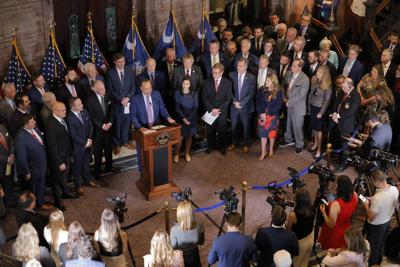
That’s an improvement from the bill as originally filed, which Republicans announced with much fanfare in the Statehouse lobby before the state’s fiscal experts could dissect it — an odd, cart-before-the-horse move. After their analysis showed the bill would actually increase taxes for nearly 60% of filers, the public backlash prompted a rewrite.
The amended bill collapses the state’s three tax rates into two, instead of moving to a single flat tax rate immediately, while promising to get there through a multi-year phase-in.
House GOP leaders point to the 2022 law that cut income taxes by more than $1 billion as proof that will happen sooner than later. That phase-in was expected to take five years. Instead, it was completed by the budget that took effect July 1.
That law passed unanimously in both chambers. Opposition to the current House GOP plan comes from two directions: The hardline House Freedom Caucus insists on the immediate elimination of state income taxes — which, by the way, still make up more than 40% of the state’s general fund revenue. Democrats argue it’s unnecessary and potentially harmful to the state’s fiscal health.
As I wrote back in April about the original bill, the push wasn’t really about cutting taxes — at least, not in year one. It’s about removing what the House’s chief budget writer, Ways and Means Chairman Bruce Bannister, calls the state’s “glaring black eye”: a tax structure that seems to be the highest in the Southeast, even though it’s not.
Even with completion of the 2022 law, the state’s top marginal income tax rate is 6%. That appears uncompetitive to our neighbors and beyond. Politicians like to point to that 6% rate when they tell voters that South Carolinians pay the highest taxes in the region. That claim is malarkey.
Because South Carolina taxes “federal taxable income,” rather than adjusted gross income as most states do, South Carolinians start their state tax forms with less income to tax, compared to what they’d file if they lived across the state border.
Their effective tax rate — what people actually pay — is comparatively low. Roughly 45% of tax filers actually pay no state income taxes at all.
Republicans want a “fair and flat” tax code that makes South Carolina stand out as a low-tax state, rather than appear the opposite. But numbers can be deceiving. That’s why the original proposal that brought the tax rate to a flat 3.99% in one fell swoop actually increased most people’s taxes.
If the Legislature adopts the tax code changes in the “Big, Beautiful Bill,” the overall cut to state income taxes would be bigger in the coming fiscal year: $515 million compared to the House GOP plan’s $400 million.
But the state’s tax rate would still appear out of whack.
“We’d still have the sticker shock problem,” Bannister told the Gazette.
“We need to get the rate down,” he said. “If we cut $500 million, we ought to do it in a way that lets us celebrate a historic tax rate decrease, not just that we’re following the feds.”
The House GOP plan would further put in state law the goal of someday, eventually eliminating state income taxes.
Just conforming to the federal code would make it “almost impossible” to also pass a bill restructuring state taxes, Bannister said.
The next move will be decided in Peeler’s committee after the Legislature returns Jan. 13.
The House bill, said the Gaffney Republican, is “heading in the right direction.”
Peeler said he wants to make sure whatever the Senate passes is an actual tax cut — a not-so-veiled swipe at the original House plan.
And, further emphasizing that the Senate will pass something, he repeated a line he’s known to make: “You can’t out-cut Harvey Peeler.”
SC Daily Gazette is part of States Newsroom, a nonprofit news network supported by grants and a coalition of donors as a 501c(3) public charity. SC Daily Gazette maintains editorial independence. Contact Editor Seanna Adcox for questions: info@scdailygazette.com.