
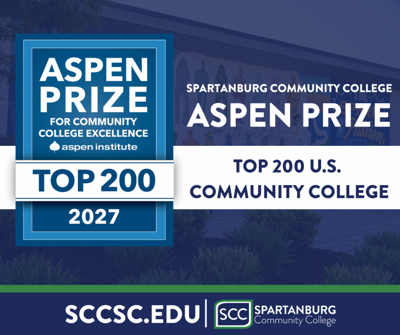
The Aspen Institute has named Spartanburg Community College as one of the 200 institutions eligible to compete for the $1 million Aspen Prize for Community College Excellence.
According to officials from the college, he Aspen Prize is a premier recognition of high achievement and performance among two-year institutions. The 200 colleges were selected based on their student outcomes data, including retention, completion, transfer and bachelor’s attainment rates. Started in 2010, this is the ninth cycle of the Aspen Prize.
“We are deeply honored to be named among the Aspen Prize Top 200 community colleges in the nation,” said Dr. Michael Mikota, president of Spartanburg Community College. “This recognition celebrates the passion and purpose that drive our faculty, staff, and students every day as we transform lives and strengthen our communities.”
The 200 schools represent a wide range of institutions. They are located in urban, rural, and suburban areas across the country and serve anywhere from a few hundred students to tens of thousands. Some of these colleges focus primarily on workforce programs, while others focus on transfer and bachelor’s attainment or a combination of the two.
“The Aspen Prize rewards colleges that achieve the kind of outcomes that actually matter to students—completing college degree programs that, in turn, lead to lifelong success,” said Josh Wyner, executive director of the Aspen Institute College Excellence Program. “Aspen Prize winners offer a powerful message: Community colleges can deliver the kind of life-changing education that makes the American Dream real.”
According to officials from the college, community colleges educate nearly six million students, yet student outcomes fall short in both graduation rate and post-graduation success. The Aspen Prize process identifies and celebrates community colleges that show that achieving stronger outcomes is possible.
The 200 eligible colleges have been invited to submit an application and participate in a rigorous review process that will culminate in the naming of the Aspen Prize winner in spring 2027. Over the coming 20 months, the colleges that apply for the Aspen Prize will be assessed based on student outcomes data, ranging from student transfer and completion rates to employment and wages after graduation. They will also be judged on whether they have engaged in scaled practices that led to high and improving student outcomes.
“Among these 200 colleges are some really special places that deliver strong and improving outcomes for students across the board,” Wyner said. “Our job over the coming 20 months is to gather a lot more data and work with a deep bench of field experts to assess which of these 200 stand out so we can not only honor them with a monetary award, but drive attention to the most effective field practices that other colleges can replicate.”
This is the first time since the inception of the Aspen Prize that 200 colleges are eligible to apply, growing from 150. This year, in addition to publicly available federal data, over 600 colleges authorized the use of National Student Clearinghouse data on their institution’s degree completion, transfer, and bachelor’s attainment rates for full- and part-time students.
The full list can be accessed on the Aspen Prize homepage. To read more about the selection process, visit as.pn/prize.