
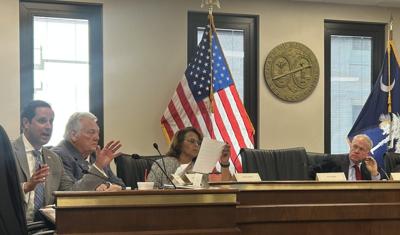

COLUMBIA — Six months after senators rejected what would have been the nation’s strictest abortion ban, another panel of South Carolina senators advanced a bill that would still prohibit abortions from the beginning of a pregnancy but impose less severe penalties.
A subcommittee with a different composition of senators rejected a harsher version in November. But in a vote of 4-2 along party lines Wednesday, a panel advanced Sen. Richard Cash’s latest attempt to ban abortions without exceptions for rape or incest, or for fatal fetal anomalies. Four Republicans and one Democrat on the panel were absent Wednesday.
The full Medical Affairs Committee, which is chaired by a co-sponsor of the bill, debated the bill Thursday but made little headway. Another meeting is scheduled Tuesday morning. What happens beyond that is unclear.
Just four weeks remain in the regular legislative session. Debate on the state budget will consume senators’ time in the chamber next week. And Senate GOP leaders indicated in January there’s little appetite for another protracted abortion debate this year.
The six-week ban that took effect in August 2023 followed months of contentious debate and multiple court fights. Even after the state Supreme Court upheld a second law, challenges about the ban’s timing continued until last May.
What the bill does
Like the bill rejected six months ago, the proposal advanced Wednesday would ban abortion from the onset of pregnancy — as soon as it’s medically detectable — and criminalize women for getting an abortion.
The previously proposed punishment helped defeat that measure. It would’ve subjected women to up to 30 years in prison.
Under Cash’s latest bill, the woman could be charged with a misdemeanor punishable by up to two years in prison and a $1,000 fine. The doctor who performs the abortion could be sent to prison for up to 20 years. The bill still uses the threat of lawsuits to help with enforcement. Family members, to include the biological father and his parents, could sue whoever aided the abortion.
His latest bill still makes it a crime to take someone under 18 out of state for an abortion without consent of the girl’s parents. But it deleted the prohibition on simply telling someone where they can get an abortion.
Included is much of a proposal the House passed earlier this year restricting access to mifepristone and misoprostol, two drugs used to induce abortions, by rescheduling them as Schedule IV drugs. The Senate has yet to take up that bill from the House.
Cash, a father of eight, has made banning abortions his central mission since he was first elected to the Senate in 2017.
Despite wanting a total abortion ban without exceptions, the Anderson Republican proposed the less strict version of the bill in hopes of getting enough support to pass, he said.
“I’m working within the political system, whereby if a bill is defeated because of a penalty, it doesn’t make any sense whatsoever to go for a stronger penalty,” Cash said Tuesday.
One senator’s story
One of the primary reasons for Cash’s bill, he said, was to stop women from getting abortions when they don’t need them.
Sen. Margie Bright Matthews called the assertion that women are getting abortions as a form of birth control “the most idiotic thing I’ve ever heard.”
Women don’t get abortions because they’re fun, the Walterboro Democrat said. They get abortions because they feel they have no other option. She has experienced that personally, she said.
“I know for sure that I am the only one up here that knows what it feels like to be pregnant and single and wondering, ‘What in the hell am I going to do?’” Matthews said.
Matthews, who is also the only woman on the 17-member Medical Affairs Committee, learned she was pregnant the same day she learned she had been accepted to law school at the University of South Carolina in 1985, she said Wednesday.
After much thought and prayer, Matthews decided to keep the baby, but that was her own decision and no one else’s, she said.
“I’m really the one that is pro-life, because when I had an opportunity, I chose to go into that house and tell my daddy that I was pregnant,” Matthews said through tears. “That was the hardest thing in the world to do.”
Matthews had support from her family and community, she said. As she raised her child while putting herself through law school, Washington Street United Methodist Church watched her then-1-year-old daughter without asking for payment, she said.
When Rev. Alston Lippert, a pastor at the church a half-mile from the Statehouse, spoke against the bill, Matthews thanked her for all the church had done to support her during her daughter’s childhood.
Other women may not have that same support, she added. Although Matthews was scared for her future when she got pregnant as a senior in college, a 16-year-old girl with unsupportive parents would likely be even more afraid and unable to raise a child.
That’s not to mention survivors of rape and incest impregnated by an abuser, Matthews said.
Since the bill has no exceptions for crime victims, “even if you’re raped, you need to have that child and learn how to love on it,” Matthews said.
“That tells me you care less about that woman and her children that she might be leaving in the house,” Matthews continued, addressing fellow senators. “You care less about her having psychological or psychiatric problems than you care about your one mantra. That is not of God.”
Two extremes
Removing the exceptions and adding punishments for the child’s mother also concerned Sen. Josh Kimbrell, who echoed worries from GOP senators last fall.
Kimbrell, who wasn’t on the panel that voted in November, said he doesn’t oppose something stricter than the existing six-week ban. But he couldn’t support punishing a woman seeking an abortion or removing the exceptions for rape, incest and fatal fetal anomalies. And yet, the Spartanburg Republican voted to advance the bill.
“I don’t want to arrest some 16-yr-old girl who’s concerned and worried, she made a mistake, and she’s going to go to jail,” said Kimbrell, who’s running for governor.
He said he also worried attempts to regulate people crossing state lines went too far. He emphasized that he didn’t fall into either end of the extremes but, like most people in the state, had opinions somewhere in between banning any abortion for any reason and allowing them to take place unregulated.
Ahead of Wednesday’s vote, about 20 people testified about the bill over two hours Tuesday.
Of them, 14 opposed the bill, repeating concerns they’ve said before that women would seek unsafe ways of getting abortions, doctors would decline to treat medical conditions for fear of punishment and drugs used in emergencies, including stopping hemorrhaging during miscarriages, might become harder to obtain.
“Let’s be honest about what (the bill) does,” said former Sen. Katrina Shealy of Lexington, who lost her seat after opposing what ultimately became law in 2023. “It places government squarely into some of the most personal, complicated decisions a woman and her family will ever face.”
Even anti-abortion advocates opposed the bill, saying it didn’t go far enough. Representatives of anti-abortion groups Equal Protection SC, Personhood SC and Christians for Personhood called for legislators to treat abortion as murder under the law.
That clearly doesn’t have enough support to pass, considering a bill doing just that failed last year, Cash said.
He would rather do something than continue to press for a bill that kept failing, he told Mark Corral, director of Equal Protection SC. The bill is an attempt to mirror what was state law before the U.S. Supreme Court’s 1973 Roe v. Wade decision, which legalized abortion nationwide through the second trimester.
“Right now, a pregnant woman has complete immunity to kill her unborn child,” Cash said. “This bill reverts to at least the historic precedent. Wouldn’t you agree that this is more just?”
SC Daily Gazette is part of States Newsroom, a nonprofit news network supported by grants and a coalition of donors as a 501c(3) public charity. SC Daily Gazette maintains editorial independence. Contact Editor Seanna Adcox for questions: info@scdailygazette.com.