


(NAPSI)—It all started about 15 years ago with a strange vibration in her left leg.
“I thought it was nothing,” recalls Suzanne Friedman, a South Florida mom who at the time was in her 40s and busy juggling a career and family.
She mentioned the vibration to her physician during an annual check-up, thinking it was probably just a pinched nerve. Instead, her physician asked a question that stopped her cold: What about Parkinson’s disease?
“What?” Suzanne remembers thinking. “I was completely shocked.”
A referral to a neurologist soon followed, along with an official diagnosis of Parkinson’s disease, news which sent Suzanne into what she describes as a yearlong tailspin.
“You don’t expect to go into the doctor’s office and walk out with a life-changing diagnosis,” Suzanne added.
April is recognized as Parkinson’s Awareness Month, a time to spotlight the experiences of the 1.1 million Americans living with the disease and raise awareness of potential treatment options1. For many people, treatments revolve around medications. In Suzanne’s case, her journey eventually led her to deep brain stimulation.
Living Around the Medication
After the news of her diagnosis settled in, she did what many patients typically do: she pushed forward.
Worried that her mobility would start to decline, Suzanne and her family traveled as much as possible before her symptoms worsened. For three years she was able to manage without medical intervention. When she finally started treatment with medications, relief came, but so did side effects.
She developed dyskinesia, the uncontrolled movements that can develop after long-term use of medications that treat Parkinson’s.
“My foot would just start tapping,” she said. “When I was nervous, it was worse.”
She began living her life around her medication and dosing schedule.
“I had to be so careful and watch every step,” she added. “I wasn’t enjoying life. I was suffering.”
Some days the medicine worked; some days it didn’t. The unpredictability was crushing and emotionally draining.
“I had no control. No consistency. I couldn’t go somewhere without worrying I suddenly wouldn’t be able to walk.”
For years, Suzanne kept her diagnosis to herself—she didn’t even tell her own mother.
“I couldn’t bring myself to tell people. I didn’t want them to freak out, because it freaked me out.”
Before Parkinson’s disease, she described herself as “the party queen,” never missing an opportunity to socialize. Over time, she became less social and any kind of stress made her symptoms worse.
Finding Another Option
When medication and other treatment options failed, she turned to late-night research and social media groups, which led her to something she hadn’t seriously considered yet: deep brain stimulation (DBS). Eager to learn more, she started reaching out to people who had undergone the procedure.
“They all said it would have a positive impact,” she added.
DBS isn’t a cure for Parkinson’s disease. The treatment works by sending mild electrical signals to a targeted portion of the brain through leads connected to a small, implanted device called a stimulator. These signals can help improve movement symptoms such as stiffness, tremors and slowness.
When Suzanne’s doctor presented her with the various DBS treatment options, she chose Boston Scientific’s Vercise Genus™ Deep Brain Stimulation System. “I wanted the most up-to-date technology available, and I liked that it had a rechargeable battery,” she added.
Suzanne began the process and had her DBS system implanted in 2018. Following the operation, she and her healthcare team worked together to fine-tune the DBS system, a painless process of making micro-adjustments to the electrical current to personalize her results.
“As the doctor started programming, my daughter watched him turn off my Parkinson’s symptoms with a computer,” Suzanne recalls.
Keep Moving to Keep Moving
Nearly 15 years after her initial diagnosis, she says you wouldn’t know she has Parkinson’s disease if you met her.
“The biggest change is consistency,” she says. “I feel like I have more control. I don’t have to worry about going somewhere and not being able to walk after.”
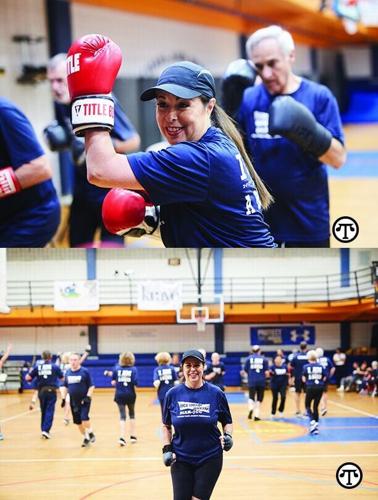
She walks three miles every day. She practices yoga. She plays cards with friends and works in the family business. Once a week, she attends Rock Steady Boxing, a non-contact fitness program designed for people with Parkinson’s disease that research suggests can help slow symptom progression.
“If you want to walk, you have to walk,” she says. “You have to keep moving to keep moving.”
Stories like this highlight why Parkinson’s Awareness Month matters: Raising awareness helps more patients and their families learn about symptoms, treatment options and supportive communities that can help them keep moving forward.
Suzanne isn’t defined by her diagnosis. She is defined by motion—by miles walked, by punches thrown in a boxing class, by trips taken, by a life lived on her own terms.
Learn More
DBS has helped an estimated 244,000 people worldwide regain control of their movement and independence in daily life2. In recognition of Parkinson’s Awareness Month, patients and caregivers are encouraged to learn more about symptoms and treatment options.
Visit DBSandMe.com to learn more about Parkinson’s disease and DBS therapy.
Results from case studies are not necessarily predictive of results in other cases. Results in other cases may vary. You can talk to your doctor about the risks and benefits of deep brain stimulation and if it is an option for you.
1. Parkinson’s Foundation. Parkinson’s Disease Statistics. https://www.parkinson.org/understanding-parkinsons/statistics
2. Sandoval-Pistorius SS, Hacker ML, Waters AC, Wang J, Provenza NR, de Hemptinne C, Johnson KA, Morrison MA, Cernera S. Advances in Deep Brain Stimulation: From Mechanisms to Applications. J Neurosci. 2023 Nov 8;43(45):7575-7586. doi: 10.1523/JNEUROSCI.1427-23.2023. PMID: 37940596; PMCID: PMC10634582.
Word Count: 847
 "Deep brain stimulation (DBS) has helped an estimated 244,000 peoplewith Parkinson’s disease regain control of their movement and independence in daily life."