

COLUMBIA — Two weeks into the financial year, legislators are still at an impasse on the state budget, with three options for moving forward, members of a negotiating committee said Tuesday.
The committee could strike more than $430 million in legislative pet projects along with expanded property tax breaks for older homeowners, removing both of the biggest sticking points from the budget. Negotiating legislators could meet in the middle, paring down both earmarks and property tax breaks to a level both chambers find acceptable.
Or, the committee could forego passing a new budget entirely, leaving annual funding at the same levels passed last year.
Since July 1, state government has operated under a stopgap known as a continuing resolution, which is generally meant to ensure the government doesn’t shut down if legislators haven’t passed a new spending plan by the start of the fiscal year.
Relying on a continuing resolution to keep funding in place for a full year is rare. While negotiations sometimes bleed into the new fiscal year, only once in the past three decades have legislators not passed a budget at all.
That was during the COVID-19 pandemic, when the legislative session ended early and global economic uncertainty led legislators to skip over the budgeting process. But even then, spending wasn’t stagnant, as the Legislature passed special legislation to allocate federal COVID aid.
Not passing a budget this year would be “an absolute failure,” House Ways and Means Chairman Bruce Bannister said Tuesday.
“I think that’s bad for the public, it’s bad for our citizens,” the Greenville Republican said. “It’s a failure of our duty to do what is necessary.”
Until a new spending plan is passed, state employees still get paid, and agencies still receive the money they need to cover operating costs.
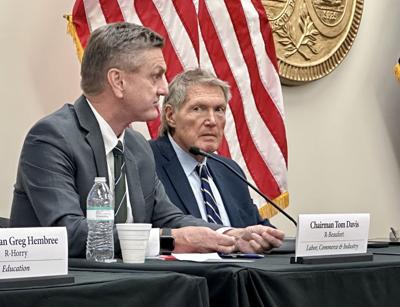
While failing to pass a budget for the year might mean certain sacrifices, agencies could move money around to cover necessary increases, Davis said. The Beaufort Republican would rather the state not pass a budget at all than pass one the Senate doesn’t like, he said.
“A far more disastrous outcome, in my opinion, is passing a bad budget that has too many earmarks and no property tax relief,” Davis told reporters.
What happens without a budget?
While agencies will continue to receive the same annual operational costs included in the 2025-26 budget if legislators don’t pass a new spending plan, they wouldn’t get any increases or one-time payments for proposed projects.
That would include scuttling projects and funding increases both chambers already agreed upon.
For instance, both spending proposals include $6 million to cover additional costs for distributing federal grocery benefits. The massive tax and spending package Congress passed last summer requires states to pick up more of the administrative costs this year to run the Supplemental Nutrition Assistance Program, commonly known as food stamps.
That’s “required to continue to administer the SNAP program as it exists today,” the agency said in its annual budget request.
It’s unclear from federal guidelines whether the program would have to stop paying benefits entirely if the state didn’t cover its share of the administrative costs, said Sue Berkowitz, director of the Appleseed Legal Justice Center, which advocates for the poor. Even if the program continued to operate, the loss could cause some of the state’s neediest people to go hungry, she said.
“It’s critical,” Berkowitz said of the money.
Both chambers spent an additional $28 million on staff and computer upgrades to reduce errors in the state’s payments. Under last year’s federal law, if the error rate doesn’t improve, the state could be required to pay between $70 million and $200 million just to keep existing benefits going next year, according to Department of Social Services estimates.
Not getting that money “could really be a problem down the road,” Berkowitz said.
The state’s Medicaid and Medicare agency also asked for more money to cover existing services.
As the population rises, the share of Medicaid and Medicare services the state must pay has increased, the agency said in a budget request. The House included nearly $103 million to continue paying for Medicaid, while the Senate recommended nearly $100 million.
If legislators were to keep the existing funding in place, the agency would consider pulling from reserves, cutting optional services and renegotiating reimbursement rates, spokeswoman Jackson Wilkens Burnaugh said in an email.
The agency “regularly evaluates how we can ensure continuity of services for beneficiaries in times of unexpected financial impacts, including operating under a continuing resolution,” Burnaugh said.
Teachers might still get promised raises, but districts could end up hurting without state funds to help cover the cost, said Debbie Elmore, lobbyist for the state School Board Association.
Legislators in both chambers agreed to increase teachers’ minimum salaries by $2,000. For first-year teachers with a bachelor’s degree, that means they can’t make less than $50,500 this school year.
Most districts in the state, anticipating the change, already passed budgets that increased teacher salaries, expecting to receive their share of state aid to cover it, Elmore said.
Without a new state budget in place, those districts would have to cover the cost themselves or go back on the raises, which many don’t even want to consider, Elmore said. Most districts have enough in their reserves to cover about three months of the increased salaries, but after that, they’ll start feeling the squeeze, she said.
“They’re going to be hurting for cash,” Elmore said.
State employees wouldn’t get their expected 2% cost-of-living increase, which both chambers agreed upon, either. Nor would legislators get an increase in their monthly allowances, which both chambers approved raising from $1,000 to $2,500.
Retirement benefits would go unchanged, according to the Public Employee Benefit Authority. Under a 2012 law, retirement checks increase 1% or $500 every year, whichever is less. Because that’s required in state law, the agency doesn’t depend on funding from the state budget for the increase, according to a spokesperson.
Other options
As a legislative stalemate continues over the merits of property tax breaks and earmarks, one possibility floated Tuesday was giving neither chamber what they wanted and zeroing out both options.
The money would instead go toward agency requests and the state’s savings, potentially including a future property tax break, Davis said.
While the Senate remains committed to expanding property tax breaks for those 65 and older, waiting another year could give the House another chance to take up a bill doing that, Davis said. The Senate advanced a proposal to expand the exemption this year, but the House didn’t take up the bill.
Cutting earmarks wouldn’t be new for legislators. Last year’s budget didn’t include the projects, either, after Bannister followed Senate Finance Chairman Harvey Peeler’s lead in taking a break from the spending.
While senators are upset the House spent more on projects, everything in the House budget benefits senators’ districts as well, Bannister said. He didn’t see the problem with spending state money on local projects, he said.
“It’s our constitutional duty to appropriate funds, so I’m not apologizing for that,” Bannister said. “That’s what we’re supposed to do.”
A compromise is another possibility. The House could reduce its earmarks to better match the Senate’s spending, and the Senate could amend its property tax expansion, Davis said.
As written, the property tax proposal would extend seniors’ existing tax exemption on a home’s value from $50,000 to $150,000, depending on how long the homeowners have lived in the state. Senators might agree to reduce that amount, essentially putting “a downpayment” on a further future expansion, Davis said.
That option could face procedural hurdles, requiring a supermajority in both chambers.
“In order to go in with a surgical knife instead of with a cleaver,” both chambers would need that special permission, Davis said.
Either outcome would be better than passing no budget at all, Senate Minority Leader Brad Hutto said.
Legislators have already agreed on most of the spending, and negotiating committee members feel they can work through other areas of disagreement, Hutto said.
Among those are whether to pay for cost overruns at the Scout Motors site, whether to fund a settlement to end a lawsuit over Captain Sam’s Spit, and whether to suspend the requirement that bars carry alcohol insurance for a year.
Legislators shouldn’t throw out all that work because they can’t agree over the final two pieces of the budget, Hutto said.
“There must be a way colloquially to skin this cat,” the Orangeburg Democrat said.
SC Daily Gazette is part of States Newsroom, a nonprofit news network supported by grants and a coalition of donors as a 501c(3) public charity. SC Daily Gazette maintains editorial independence. Contact Editor Seanna Adcox for questions: info@scdailygazette.com.